Free Diagnostic Guide
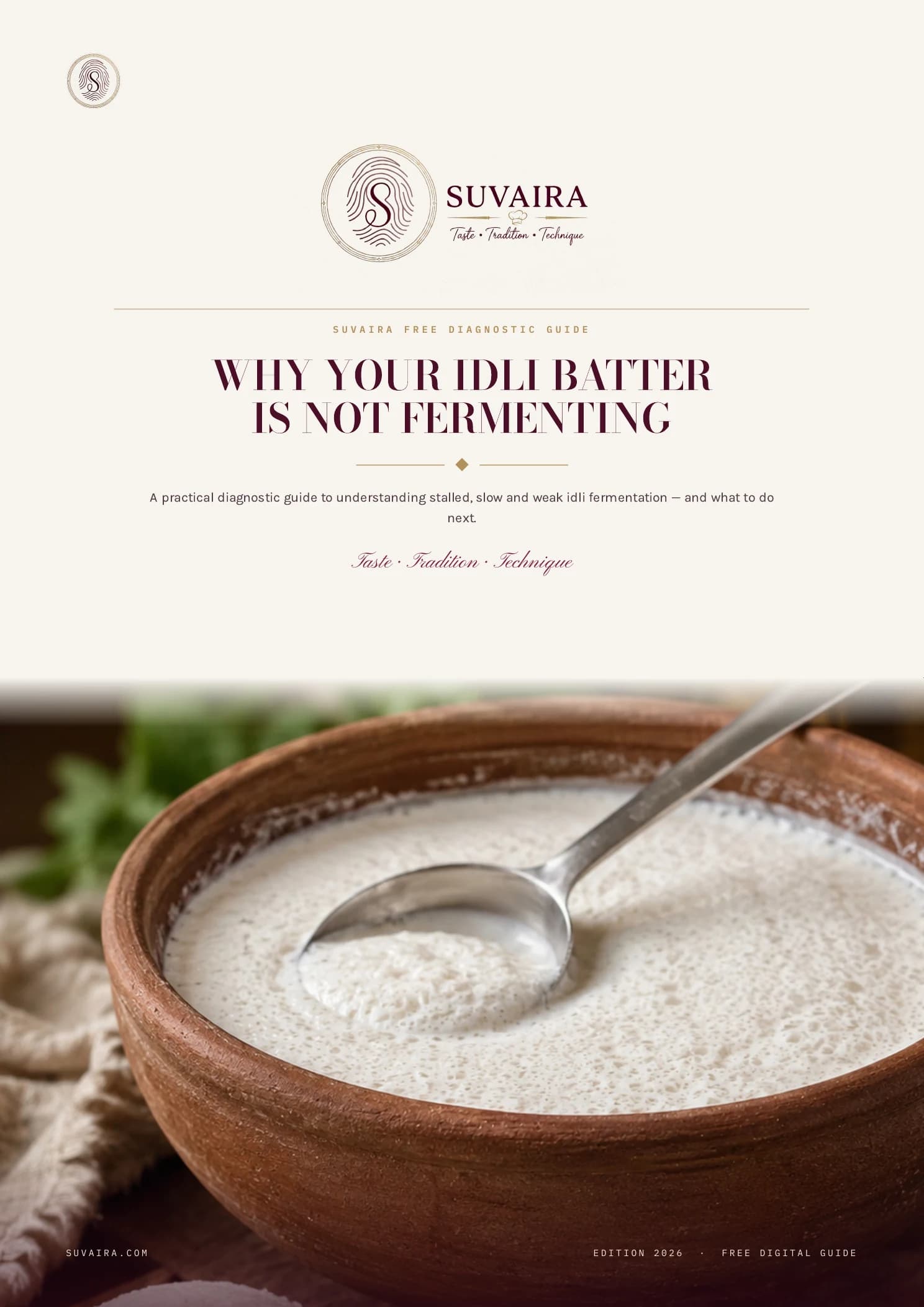
Why Your Idli Batter Is Not Fermenting
A batter that appears stalled may simply be being judged by time alone. This guide gives you the four readiness cues, then works backwards from the symptom.
FreeDigital guide · PDF download
What this guide helps you control
- The four readiness cues — volume, surface, texture and aroma
- Telling under-fermented from ready from over-fermented
- Why elapsed hours are context and the batter is the evidence
- Warming methods for a kitchen below the working zone
- When more time is not the answer
What’s inside
- Before you call the batter failed — a diagnostic orientation
- The four readiness cues, read together rather than singly
- Side-by-side under-fermented / ready / over-fermented comparison
- Warming methods for cool kitchens
- A fermentation failure atlas covering eight recurring problems
Inside the Guide
Two pages from the guide.
Select a page to view it enlarged. These are complete pages, shown at readable size — not marketing mock-ups.
Start Here
Why Your Idli Batter Is Not Fermenting
Judge the batter, not the clock
Most batters described as “failed” have simply been judged by elapsed hours. Eight hours in a cold kitchen and eight hours in a warm one are not the same eight hours. Before concluding anything has gone wrong, read the batter itself.
A batter is ready when four cues agree: a clear visible rise of roughly 50–100%, fine bubbles across the surface with a slight dome, a texture that is airier and lighter on the ladle than when freshly ground, and a clean, mildly tangy aroma rather than a raw or sharply acidic one. One cue arriving early is not readiness.
Temperature is the usual culprit
Idli fermentation is driven by bacteria and wild yeast that work well in a warm room and slow dramatically as the kitchen cools. A batter sitting in an air-conditioned kitchen, a cold climate, or overnight in a draughty spot can stall almost completely while looking untouched.
The practical fix is to arrange a reliably warm spot before you mix, not after the batter is already cold. An oven with only the light on, a closed cupboard near a warm appliance, or a covered vessel wrapped in a cloth all work. Warmth applied late rescues a batch far less reliably than warmth planned early.
Other common causes of a weak rise
Batter overheated during high-speed blending. A domestic blender generates real heat, and a batter that comes out warm has already been partly damaged before it starts. Using ice-cold water while grinding is the standard preventative.
Weak aeration in the urad grind. The urad dal carries most of the air that becomes lift. If it was ground dense rather than light and fluffy, the batter starts with little to expand.
Water quality. Heavily chlorinated water can suppress the organisms doing the work; filtered or non-chlorinated water avoids the question entirely.
Salt timing in a cold kitchen. Where the room is cool, salt going in before fermentation can slow an already-slow process.
When more time is not the answer
A batter that rose and then collapsed, smells sharply acidic, and has lost body has gone past readiness rather than fallen short of it. More time makes this worse. Refrigerate it and use it for dosa, uttapam or paniyaram, where extra tang is an asset rather than a fault.
Ordinary sourness on its own is not spoilage — it is a fermentation and quality question. Visible mould, unusual discolouration or a putrid smell are different, and mean the batter should be discarded.
The free diagnostic guide below sets this out as a structured symptom-to-cause map you can work through at the bench.
Who this is for
- Anyone whose batter has not risen and does not know why
- Cooks in cold climates or air-conditioned kitchens
- Cooks who have switched from a wet grinder to a blender
- Anyone new to SUVAIRA who wants to see how we work before buying
What this is not
- Not the complete idli batter system — it is a diagnostic starting point
- Not a grinding, hydration or steaming guide
- Not a food-safety authority on spoilage
Digital format
A digital PDF you download and keep, readable on phone, tablet, laptop or printed for the kitchen wall. Purchasing grants a licence to use the guide — it does not transfer ownership, and the guide may not be resold or redistributed. See the Terms for the full licence.
Go Deeper
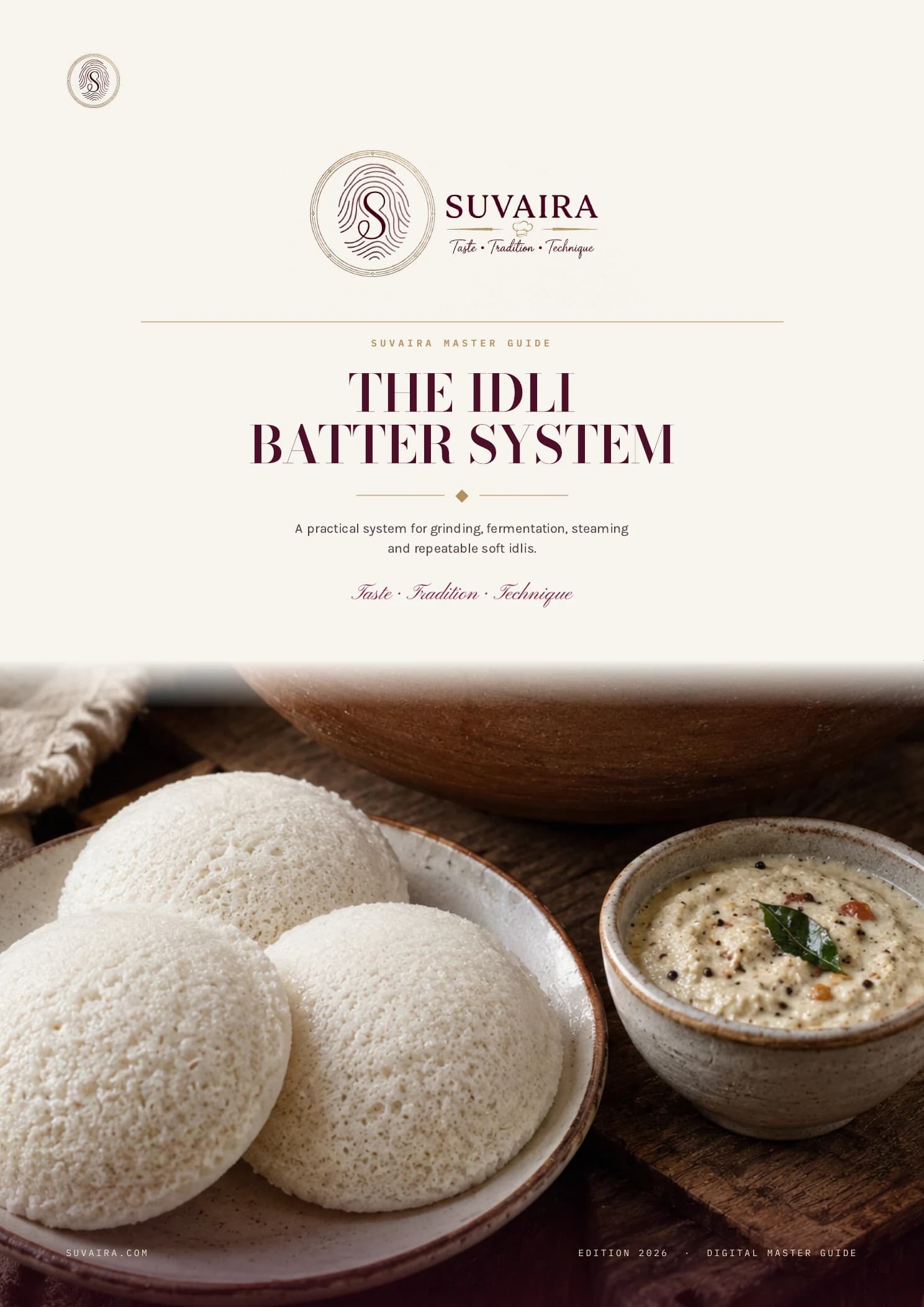
The Idli Batter System
Grinding, fermentation and steaming as one controlled system.
This free guide diagnoses the problem. If you want the complete system behind it — formula, stage-by-stage control points and full troubleshooting — that is what The Idli Batter System covers.