Free Diagnostic Guide
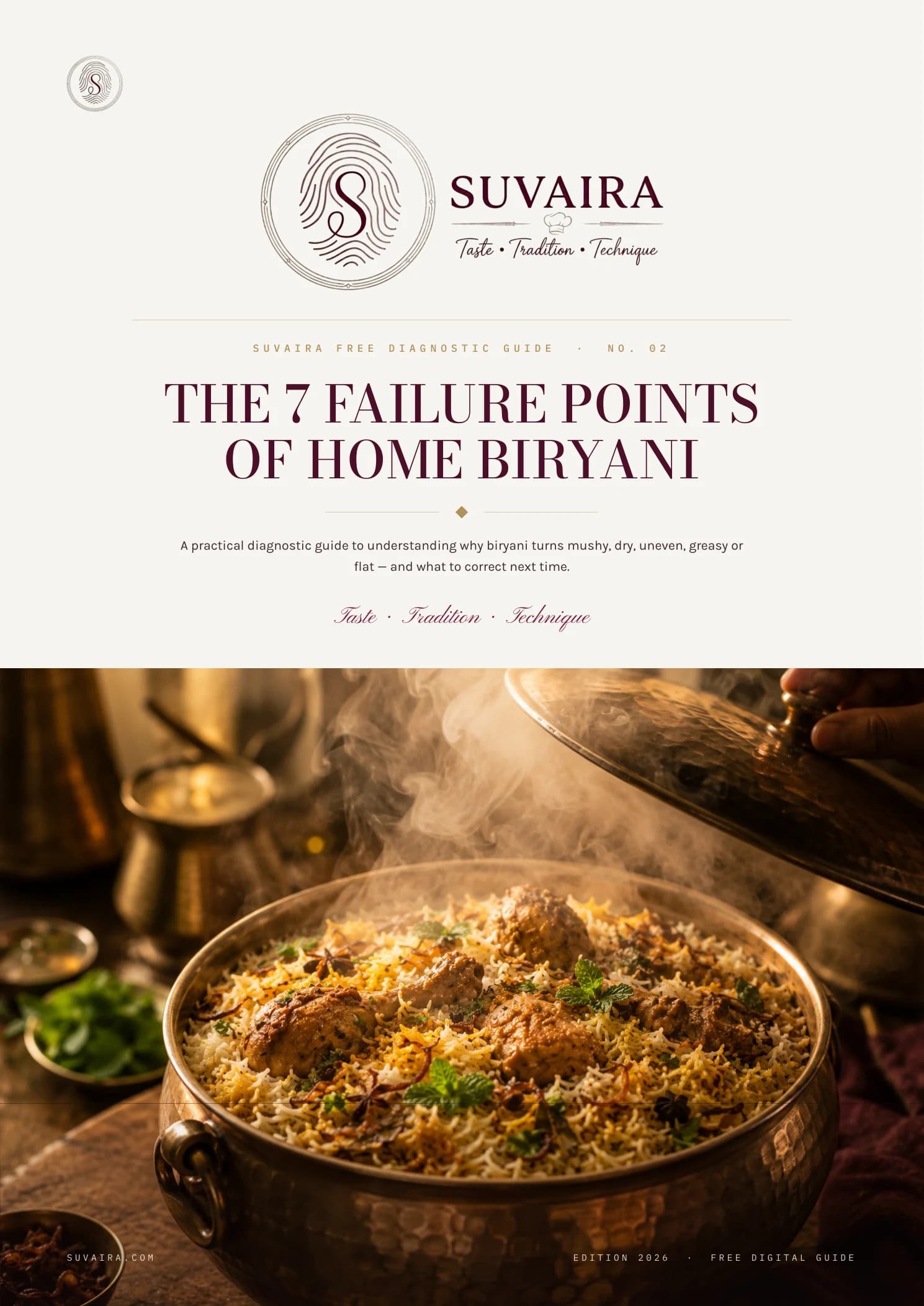
The 7 Failure Points of Home Biryani
Home biryani failures are rarely caused where they are noticed. Start with the symptom in front of you, then work backwards to the stage most likely responsible.
FreeDigital guide · PDF download
What this guide helps you control
- Reading the pot backwards from the symptom to the stage
- The seven failure points, from rice control through to serving
- Counting every moisture source before the lid goes on
- Where seasoning and aroma actually enter the pot
- Why changing one stage at a time teaches you more than changing five
What’s inside
- A diagnostic map from symptom to responsible stage
- The seven failure points, each explained in full
- A home biryani failure atlas covering twelve recurring problems
- Method-dependent guidance flagged as method-dependent
- Guidance written as a starting point rather than a verdict
Inside the Guide
Two pages from the guide.
Select a page to view it enlarged. These are complete pages, shown at readable size — not marketing mock-ups.
Start Here
The 7 Failure Points of Home Biryani
Start with the symptom, work backwards
Home biryani failures are rarely caused where they are noticed. A wet base is seldom only a dum problem, and mushy rice is seldom only a rice problem. The useful move is to identify the single stage most likely responsible, change that one thing, and read the next pot.
A biryani that changed in five places at once teaches you nothing about which change mattered — and the next failure will be just as hard to read.
Moisture balance is the most common cause
Count every source of liquid entering the pot before the lid goes on: the water the rice still holds after draining, the moisture in the masala, any curd or marinade, and the liquid released by the meat during dum. Most “too wet” and “too dry” outcomes are decided here, not during the dum itself.
A base still holding free liquid at layering will almost always give a wet, soupy bottom. A base reduced past the point of giving anything back will give a dry pot that resting cannot rescue.
Rice doneness before layering
The rice must enter the dum with the right amount of cooking still ahead of it. Taken too far before layering, it meets more moisture than the grain can absorb and collapses into mush. Left too firm for the dum that follows, it stays chalky at the centre.
The correct stage depends on the method you are running. A raw-marinated dum, where the meat cooks under the rice, does not behave like a method where the meat and masala are finished before layering — so an instruction taken from one method should not be carried into the other.
Heat, seal and the dum
A domestic burner delivers its heat to a small circle in the middle of the base, which is why the centre scorches while the edges stay wet. A flat tawa or heat diffuser under the pot is what makes a low setting usable.
Read the dum by sound and steam rather than by the clock: a thin, steady line of steam at the rim and a soft irregular tick from inside indicate correct heat. An audible rolling boil is too high; complete silence and a merely warm lid is too low.
The rest after the heat goes off is not a courtesy pause. At the end of the dum the grains are hot, fully hydrated and physically fragile, and there is still a moisture gradient between the wet base and the drier top. Resting lets that redistribute and lets each grain firm up enough to survive being folded.
Seasoning and aroma are distribution problems
Flavour that is uneven, or aroma that is weak by the time it reaches the plate, usually means seasoning and aromatics were concentrated in one part of the pot or added only at the top, rather than built through the layers.
Aroma also escapes quickly once the lid comes off, so a pot opened early and held loses much of what it had.
The free diagnostic guide below sets this out as a structured symptom-to-cause map you can work through at the bench.
Who this is for
- Cooks whose biryani is different every time
- Anyone with a wet base, a dry top, or both at once
- Cooks who follow a recipe but cannot diagnose the result
- Anyone new to SUVAIRA who wants to see how we work before buying
What this is not
- Not a biryani recipe — it is a diagnostic guide
- Not specific to one region or method
- Not a substitute for a full execution system
Digital format
A digital PDF you download and keep, readable on phone, tablet, laptop or printed for the kitchen wall. Purchasing grants a licence to use the guide — it does not transfer ownership, and the guide may not be resold or redistributed. See the Terms for the full licence.
Go Deeper
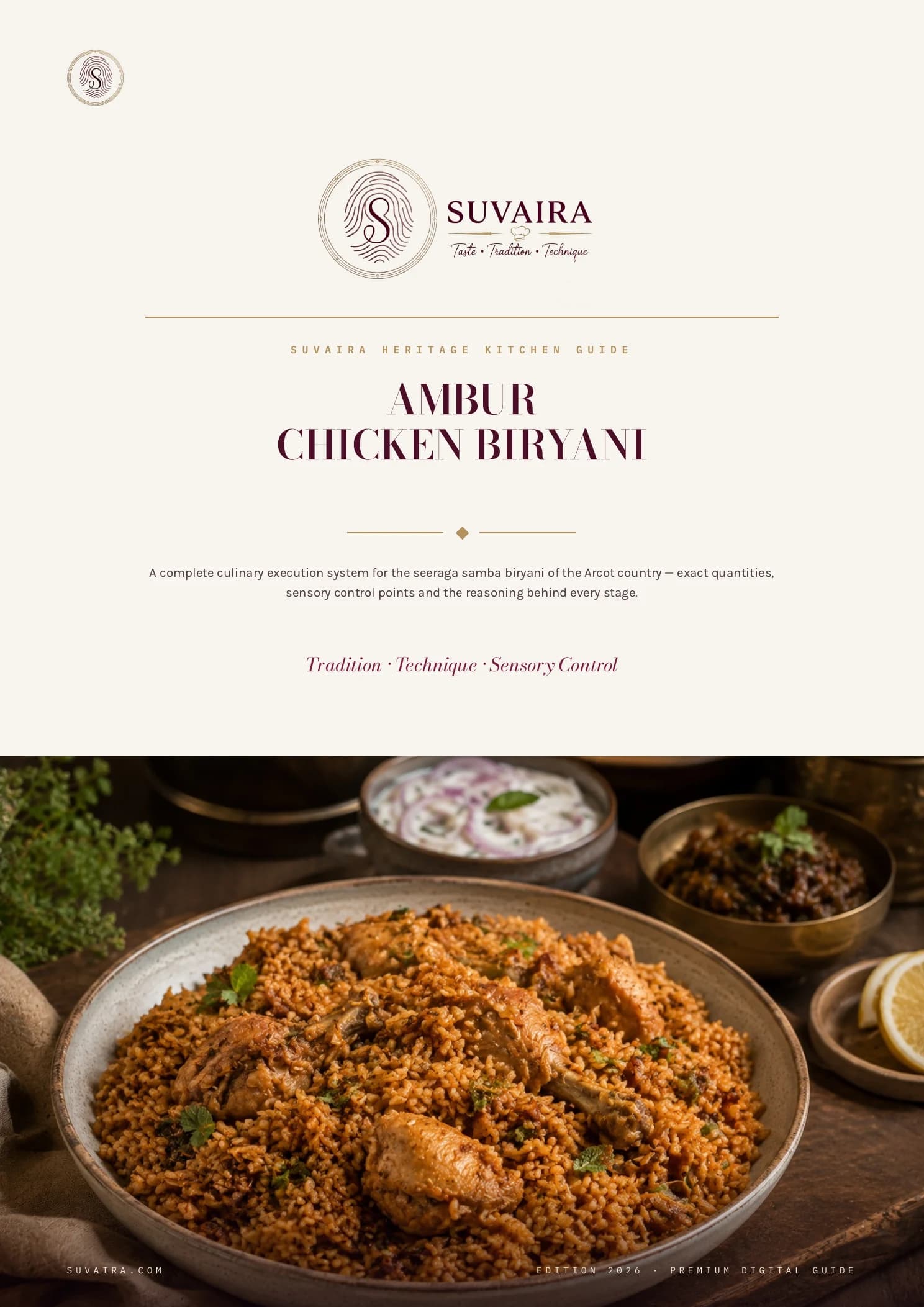
Ambur Chicken Biryani
The seeraga samba biryani of the Arcot country, with exact quantities.
This free guide diagnoses the problem. If you want the complete system behind it — formula, stage-by-stage control points and full troubleshooting — that is what Ambur Chicken Biryani covers.